
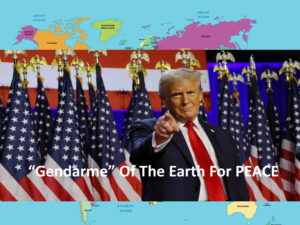
Why I Support Trump During the Iran Conflict: A French-American CEO’s Perspective
For weeks now, I have received messages—especially from friends and contacts in France and across former French-speaking regions—asking me one simple question:
“Why do you support Donald Trump, especially during this conflict with Iran?”
Instead of answering individually, I want to share my perspective openly.
This is not about politics as usual. This is about experience, observation, and what I believe leads to peace in a complicated world.
A Journey That Shaped My View
When I first arrived in France in 1987, I began hearing about Iran through the media. One name appeared frequently: Reza Pahlavi, son of the former Shah of Iran, living in exile. That was my first exposure to the Iranian story.
Years later, after moving to the United States in 2008, I lived near Santa Monica Beach. There, I joined a regular “French group”—a diverse community of people who had lived in France: Algerians, Moroccans, Tunisians, Lebanese, and many Iranians.
I was the only Black woman in that group. Naturally, I asked questions.
Why were there so many Iranians?
Why did they speak French?
Their stories were powerful. Many had fled Iran because of the regime. France was often their first refuge—partly because of historical ties and exile networks. Then, like many immigrants, they came to the United States seeking stability, opportunity, and freedom.
Later, working in the dental field, I met many highly educated professionals originally from Iran. Their stories were consistent: talent, resilience, and a deep understanding of what it means to lose a country to instability.
These experiences stayed with me.
Understanding the “Gendarme of the World”
In France, there is a common expression:
“Les Américains aiment jouer les gendarmes du monde.”
(“Americans like to play the police officer of the world.”)
It is often used critically—as if the United States interferes too much.
But today, I see it differently.
Sometimes, being the “gendarme” is not about domination—it is about responsibility.
The Reality of Global Stability
Right now, the Strait of Hormuz is at the center of global tension. This narrow passage is essential for oil shipments worldwide.
Recent reports confirm that the situation remains volatile. There are discussions about a possible ceasefire, with claims that Iran signaled willingness to stop fighting—though this is disputed and still unclear. ()
What is not disputed is this:
- The Strait of Hormuz is critical to global trade
- Its disruption affects countries far beyond the Middle East
- Energy prices, supply chains, and economic stability depend on it
Without strong intervention, the consequences could escalate into wider international conflict.
Peace Through Strength
This is where I align with President Donald Trump’s philosophy:
“Peace Through Strength.”
It is easy to call for peace.
It is harder to enforce the conditions that make peace possible.
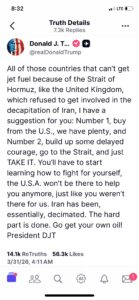
From my perspective, Trump’s approach is not about seeking war—it is about preventing a larger one.
If shipping routes are blocked, if countries cannot access energy, if instability spreads—then multiple nations become involved. That is how global wars begin.
In that sense, acting firmly—even militarily—can sometimes prevent something far worse.
A Difficult Truth
There is a truth many people are uncomfortable with:
Sometimes, the path to peace goes through conflict.
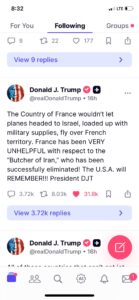
History has shown this repeatedly.
This does not mean war is desirable.
It means that in certain situations, inaction can be more dangerous than action.
Why I Speak Up
As someone who has lived in different countries, listened to real stories from immigrants, and built a life in the United States, I cannot ignore what I have seen and heard.
I have met people who escaped instability.
I have met people who rebuilt their lives from nothing.
I have seen what happens when governments fail to protect freedom and economic stability.
So, when I look at today’s situation, I do not see it only through headlines.
I see it through people.
Hope for What Comes Next
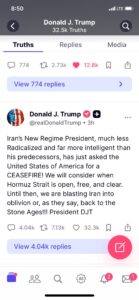
As of today, April 1, 2026, there are discussions about a ceasefire.
Whether this becomes reality or not remains uncertain. Some claims have already been denied, and the situation is still evolving. ()
But one thing is clear:
The world is watching.
The stakes are global.
And the decisions being made now will shape the future of international peace and trade.
Final Thoughts
Supporting strong leadership does not mean supporting war.
For me, it means supporting the idea that:
- Stability matters
- Trade matters
- Freedom of movement matters
- And sometimes, strength is required to protect all of the above
If being a “gendarme of the world” means ensuring that chaos does not spread, then perhaps it is not something to criticize—but something to understand more deeply.