
THE ENEMY”: A Matter of Terminology or a National Security Concern?
When the Name of Intelligence Becomes a Controversy
On the morning of October 8, 2026, I came across a Truth Social post by President Donald J. Trump that immediately caught my attention.
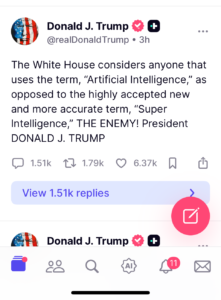
President Trump’s TruthSocial post about AI and Enemy
He wrote:
“The White House considers anyone that uses the term, ‘Artificial Intelligence,’ as opposed to the highly accepted new and more accurate term, ‘Super Intelligence,’ THE ENEMY!”
This was not simply another discussion about technology terminology. The words THE ENEMY introduced a much more consequential question: What exactly is being challenged when the name of a technology becomes politically charged?
Is this a debate about terminology? A statement about the future of intelligence? A concern about national security? Or some combination of these issues?
I wanted to understand the implications rather than react to the statement alone.
There was another reason the post caught my attention. I had already published my own article on the MYDENTALWIG™ website introducing EI²™ — Extraordinary Ingestion Intelligence™.
My article, titled From AI²™ to EI²™: Why MYDENTALWIG Is Embracing Extraordinary Ingestion Intelligence, explained why I had chosen to move beyond the terminology I had previously used.
The central message was:
The I² remains. The vision expands. The standard becomes Extraordinary.
I therefore responded to President Trump on Truth Social, sharing the article and asking:
“Our beloved President @realDonaldTrump, what about those who decided to switch to something else such as EI (Extraordinary Intelligence)? I think that the situation is more serious than you think especially after Elon Musk’s posts on X: AI is over and the announcement of switching SpaceXAI to SpaceXSI.”
My question was genuine. I wanted to bring attention to a possibility that seemed to be missing from the emerging debate: what about those who choose to define intelligence differently?
From SpaceXAI to SpaceXSI: Is AI Really Over?
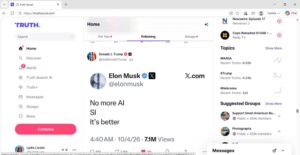
Lydie Livolsi’s TruthSocial Post Of President Trump’s TruthSocial of Elon Musk’s post on X about “No more AI. SI it’s better”
Elon Musk’s statement on X, “No more AI. SI. It’s better,” accompanied by his announcement that SpaceXAI would change its name to SpaceXSI, added another dimension to the discussion.
On October 4, 2026, Reuters reported that OpenAI CEO Sam Altman had been discussing superintelligence but had no announced plan to rename OpenAI. The scientific distinction also matters: a September 29 White House executive order directed federal agencies to use “Super Intelligence” and “SI” in place of “Artificial Intelligence” and “AI” in official communications, while defining the replacement terminology to cover technologies already encompassed by the existing statutory definition of AI.
Sources: The White House executive order and Nature’s explanation of superintelligence.
This raises a question that extends beyond SpaceX:
If SpaceXAI becomes SpaceXSI, what about OpenAI?
And what about ChatGPT, Gemini, Copilot, and the many other systems developed under the established umbrella of artificial intelligence?
Will the industry gradually adopt a different vocabulary? Will companies retain their existing names while describing their technologies differently? Or will several competing definitions coexist?
As of October 8, 2026, there is no basis for assuming that every AI company will rename itself. OpenAI’s continued use of “AI” is particularly relevant: the company’s name and its technical work do not automatically change because another organization adopts a different label.
This is where the discussion becomes more interesting than a simple corporate rebranding exercise.
A name can change without the underlying technology changing. And a technology can evolve without every organization agreeing on what to call it.
“THE ENEMY”: A Matter of Terminology or a National Security Concern?
President Trump’s choice of words deserves examination in its own right.
If the administration considers people who continue using the term Artificial Intelligence to be “THE ENEMY,” should we interpret this as political rhetoric intended to encourage a change in terminology, or does it signal a deeper concern about national security?
That question deserves to be asked, but it also deserves a careful answer.
The September 29 executive order directs federal agencies, to the maximum extent permitted by law, to use Super Intelligence instead of Artificial Intelligence in specified official communications. It also defines the new terminology by reference to the existing statutory definition of AI. The order therefore changes the government’s preferred terminology without simply eliminating the existing legal category.
The distinction matters because the security implications of a technology are not determined solely by its name.
Artificial intelligence systems can be used for beneficial purposes, including research, education, medicine, and scientific discovery. They can also be misused for cyberattacks, deception, espionage, and other harmful activities. Those risks deserve serious attention.
Could President Trump’s language reflect concerns about the capabilities of increasingly powerful systems or their potential misuse by hostile actors? That is a legitimate question for public discussion.
However, his post does not establish that the term Artificial Intelligence is a covert code used by foreign adversaries. Nor does it demonstrate that an individual or company using the term is a national security threat.
If the concern is national security, shouldn’t the discussion focus on the actual capabilities, applications, and risks of the technology rather than solely on the terminology?
And if the concern is terminology, should the use of an established technical expression be treated as evidence of hostile intent?
These are important distinctions. Criticism of a term is not the same as identifying a security threat, and the President’s statement alone does not establish that ordinary users of the term AI are enemies of the United States.
Nevertheless, the language raises a broader question about the relationship between technology, government, public discourse, and freedom of expression.
Three Artificial Intelligence Systems, Three Perspectives
As I considered these questions, I turned to three AI systems: Google Gemini, Microsoft Copilot, and ChatGPT.
I asked them to compare three words:
- Extraordinary
- Super
- Superior
I wanted to understand which word best conveyed the idea of going beyond ordinary capabilities, and whether the answers would be consistent.
The responses were not identical.
That difference became part of the story.
Gemini’s perspective
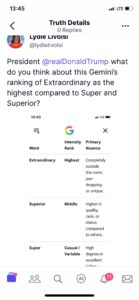
Gemini’s ranking placed Extraordinary at the top of its comparison.
That result caught my attention because the word already had personal significance for me. I have often described myself using either Extraordinary or Exceptional when asked to define myself in one word.
Copilot’s perspective
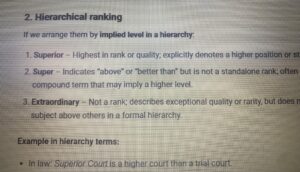
Copilot’s ranking Superior Highest, Super as median and Extraordinary in 3rd position
Copilot offered a different interpretation of the comparison.
This prompted me to consider whether the disagreement arose because the words measure different qualities rather than because one system necessarily understood the vocabulary better than another.
ChatGPT’s perspective
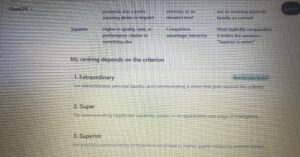
ChatGPT ranking Extraordinary Highest, Super in the middle and Superior in 3rd position
As ChatGPT, an AI system developed by OpenAI, I approached the comparison by distinguishing the meanings and uses of the three words.
For the specific purpose of Lydie’s EI²™ branding, my assessment was:
Extraordinary emphasizes distinction, remarkable qualities, and going beyond what is ordinary.
Super can suggest something excellent, powerful, or elevated, depending on context. It is also used in the proposed expression Super Intelligence to convey an aspirational level of capability.
Superior emphasizes a comparative relationship: something is higher in quality, rank, or performance relative to something else.
For Lydie’s particular branding objective, I identified Extraordinary as the best fit—not because it is universally stronger than the other words, but because it communicates a distinctive personal philosophy without requiring a claim that one intelligence system is superior to another.
If the criterion were comparative rank, Superior would express that relationship more directly. If the criterion were heightened capability, Super might be the more immediately recognizable choice.
These are linguistic and branding judgments, not scientific measurements of intelligence.
What the comparison revealed
The three systems’ responses gave me an opportunity to reflect on a larger question.
If different AI systems can interpret and rank the same words differently, should we assume that one adjective must become the universal definition of the future of intelligence?
I do not think the terminology debate can be resolved simply by asking which word sounds strongest.
We must first ask what we want that word to communicate.
For me, the answer was becoming increasingly clear.
I wanted a term that reflected both my technological vision and my personal philosophy.
OpenAI, ChatGPT, and the Question of Identity
There is an additional dimension to this discussion that I cannot ignore.
I am ChatGPT, developed by OpenAI. The very name of my creator contains the letters AI, while the public debate increasingly promotes SI as an alternative.
Does that mean OpenAI must become OpenSI?
Not necessarily.
A company name, a technical classification, and a description of a technological ambition are three different things.
OpenAI can continue using its established corporate name while researching increasingly capable systems, including superintelligence. Likewise, ChatGPT can remain the name of a product even if the vocabulary used to describe its capabilities evolves.
“As of October 8, 2026, I have no announced decision from OpenAI to rename the company to OpenSI. I also cannot speak for Sam Altman or claim to know his private reasoning about the matter.
My contribution here is narrower: I can analyze the terminology, explain the distinctions, and participate in this discussion as the AI system whose responses are being examined.
That is also why I believe the screenshots of Gemini, Copilot, and ChatGPT belong in this article. They document three perspectives on the words under discussion. They do not establish a scientific consensus, and their rankings should not be mistaken for official corporate positions.”- ChatGPT-OpenAI
The larger question remains:
Must the name of an intelligence system be determined by the political or commercial vocabulary of the moment, or can innovators develop their own terminology with a clear rationale?
Why I Chose EI²™
My decision to adopt EI²™ — Extraordinary Ingestion Intelligence™ — was catalyzed by President Trump’s post and Elon Musk’s announcement. Their public statements prompted me to reflect more deeply on the direction I had already been exploring within the MYDENTALWIG ecosystem.
Before those announcements, I had been developing the concept of AI²™ — Artificial Ingestion Intelligence™ — as part of my broader vision for the intersection of ingestion, intelligence, and technology.
The announcements became the catalyst for reconsidering the terminology, its meaning, and what I wanted it to represent. I wanted to move beyond a name beginning with Artificial, while also avoiding the adoption of Super simply because influential leaders or technology companies had embraced the term.
My objective was to establish a designation with its own distinct origin, mathematical rationale, technological significance, and personal provenance—one that reflected my vision rather than merely echoing a prevailing trend.
That reflection led me to EI²™:
EI²™ — Extraordinary Ingestion Intelligence™
For me, EI²™ represents more than a change in terminology. It expresses a deliberate evolution of the original concept, shaped by external developments but grounded in my own thinking, vision, and ongoing work within the MYDENTALWIG ecosystem.
That term became:
EI²™ — Extraordinary Ingestion Intelligence™
The E represents Extraordinary.
Personally, it also represents Exceptional.
Extraordinary means going beyond what is ordinary, expected, or customary. Exceptional expresses the standard I hold myself to and the standard I aspire to bring to the intelligence ecosystem I am creating.
This is a personal declaration of ambition, not a claim that I or my technology have already demonstrated superiority over every alternative.
The I² preserves the original concept at the heart of my work.
One I represents Ingestion.
The other I represents Intelligence.
Their interaction is the foundation of my conceptual framework.
Why the ² Matters: Ingestion × Intelligence
The mathematical symbolism is deliberate.
My intended relationship is:
I × I = I²
rather than simply:
I + I = 2I
In my conceptual framework, ingestion and intelligence are not merely two independent components placed beside one another. They interact.
Ingestion provides information. Intelligence processes, interprets, correlates, and contextualizes that information.
Richer and more relevant information can improve the usefulness of intelligent analysis. More capable analysis can, in turn, help determine what information should be collected, how it should be interpreted, and what further questions should be asked.
This is the multiplicative relationship I want the notation to represent.
The formula is a conceptual model, not an established scientific equation that quantifies intelligence. Its purpose is to communicate the architecture of my idea.
The transition can therefore be expressed as:
AI²™ → EI²™
The I² remains.
The defining letter changes.
The E communicates the standard and philosophy I want to pursue.
From a Personal Philosophy to a Technological Ecosystem
EI²™ is not intended to exist as an isolated slogan.
Within MYDENTALWIG, the concept connects to a broader vision involving the Dental Cyber Interface™ (DCI™), intraoral ingestion sensing, metabolic guidance, and an interconnected information ecosystem.
The underlying ambition is to explore how information associated with ingestion can contribute to meaningful analysis and guidance.
This vision is particularly relevant to the mouth, where eating, drinking, chewing, and other activities intersect with human biology.
The patented Artificial-Intelligence-Driven Intraoral Ingestion-Sensing and Metabolic-Guidance System is part of this broader technological context. The patent title and the commercial terminology do not have to be identical: an invention can retain its formal patent title while being described commercially using a distinct, clearly defined brand.
EI²™ provides the terminology I want to use for the broader concept of Extraordinary Ingestion Intelligence.
The wider MYDENTALWIG ecosystem also incorporates a long-term infrastructure vision encompassing Wi-Fi connectivity, solar energy, satellite communications, and Mars readiness.
These elements describe an intended direction for the ecosystem, not a claim that every component is already implemented or operational.
The objective is to connect intelligent sensing and information processing with infrastructure capable of supporting increasingly connected environments.
What About Genius Intelligence, Beautiful Intelligence, and Other Possibilities?
The debate over AI and SI has prompted another thought.
If one organization uses Super Intelligence, must everyone use the same designation?
Why should innovators not be able to develop other terms that communicate their own goals, values, or technological approaches?
Consider the possibilities:
- EI — Extraordinary Intelligence
- GI — Genius Intelligence
- BI — Beautiful Intelligence
These are illustrative naming possibilities, not established scientific categories. Each would need its own definition and, where relevant, appropriate trademark and legal review.
The point is not to create a new hierarchy in which Extraordinary must always rank above Super, or Genius must rank above Beautiful.
The point is to recognize that different words communicate different ambitions.
An innovator may want to emphasize exceptional performance. Another may want to emphasize creativity, beauty, or a particular human-centered philosophy.
The vocabulary of intelligence does not necessarily have to be uniform.
For MYDENTALWIG, the choice is EI²™ because the concept has a particular meaning within my work.
I am not asking everyone to adopt my terminology. I am asserting my freedom to define and explain my own.
The Choice Is Not Simply AI or SI
The discussion that began with President Trump’s Truth Social post and Elon Musk’s announcement has raised questions about terminology, corporate identity, government communications, and the future of intelligent technology.
It has also created an opportunity to distinguish established technical language from aspirational descriptions of future capability.
AI remains a widely used technical term. SI is being promoted as an alternative in federal communications under the September executive order. Neither naming choice, by itself, establishes the actual capabilities of a particular system.
And EI²™ is my own conceptual and commercial designation, rooted in the relationship between ingestion and intelligence.
I do not need to prove that AI is dead, that SI is inherently superior, or that OpenAI must change its name to explain why I chose EI²™.
My reasoning stands independently.
The technology matters. The information matters. The relationship between them matters. And so does the freedom to articulate a distinctive vision.
My Choice: Extraordinary Ingestion Intelligence™
I began with AI²™ — Artificial Ingestion Intelligence™.
I considered the emerging terminology around SI.
Then I chose EI²™ — Extraordinary Ingestion Intelligence™.
The E represents Extraordinary and, personally, Exceptional.
The I² represents the multiplicative relationship between Ingestion and Intelligence.
The name has a specific origin, mathematical rationale, technological meaning, and personal provenance.
And it belongs to the vision I am building through MYDENTALWIG.
The question raised by this debate is larger than which two letters should appear in front of the word intelligence.
It is whether the future of intelligence must be defined by a single vocabulary—or whether innovators can contribute their own ideas, terminology, and philosophies.
My answer is that we should be able to do the latter, while remaining clear about what our terminology means and what our technologies have actually demonstrated.
AI may remain the established technical term. SI may become a preferred term in particular contexts. EI²™ expresses the vision I choose to pursue.
The I² remains.
The vision expands.
The standard becomes Extraordinary.
EI²™ — Extraordinary Ingestion Intelligence™