
We should not wait until we reach space to learn how to integrate the infrastructure that makes life and industry possible. We should build, test, and improve those systems on Earth—with space in mind.
How the MYDENTALWIG ecosystem envisions a new approach to integrated infrastructure, intelligent cities, and humanity’s future beyond Earth.
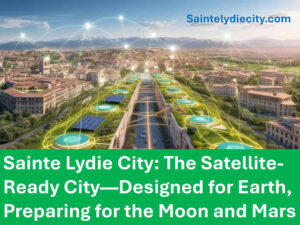
What if preparing humanity for life beyond Earth began not with a rocket, a spacecraft, or a lunar habitat, but with the way we design a city?
What if the infrastructure required to support a connected, intelligent, energy-resilient city on Earth could also provide a foundation for developing technologies that may one day support satellite operations, lunar infrastructure, and human missions to Mars?
This is the question at the heart of the Sainte Lydie City vision developed through the MYDENTALWIG ecosystem.
The premise is straightforward: rather than building a city first and retrofitting its infrastructure as new technologies emerge, we can plan the physical, digital, energy, industrial, and operational systems together from the beginning.
We can design for the needs of people living on Earth today while anticipating the technological challenges of tomorrow.
Sainte Lydie City represents a vision of integrated infrastructure: a city designed not only to accommodate technology, but to make technology work together.
- The Missing Connection: Designing Infrastructure as One System
Modern cities depend on many interconnected systems.
Electricity powers buildings, manufacturing, computing, and communications. Fiber-optic networks carry data. Wi-Fi and cellular networks connect people and devices. Water and wastewater systems support communities and industry. Roads, buildings, distribution facilities, and industrial sites make economic activity possible.
Yet these systems are frequently planned, financed, constructed, and operated through separate projects, organizations, and timelines.
The result can be costly retrofits, duplicated infrastructure, fragmented data systems, unnecessary energy consumption, and missed opportunities to improve efficiency through coordination.
Now consider a different approach.
Imagine planning a city in which energy generation, battery storage, electrical distribution, fiber-optic connectivity, wireless networks, satellite communications, computing resources, industrial facilities, and intelligent building systems are considered together from the earliest stages of development.
The objective would not be to predict every technology that will exist decades from now.
It would be to establish an adaptable foundation capable of accommodating technological change.
That is the opportunity behind Sainte Lydie City.
Instead of treating infrastructure as a collection of independent utilities, the city could be developed as a coordinated platform for residential life, commerce, manufacturing, research, healthcare, and emerging technologies.
And that approach has implications far beyond conventional urban development.
- Satellite-Ready Begins on Earth
Satellite connectivity is already changing how people, businesses, remote communities, transportation systems, and industrial operations access communications services.
But connecting a city to a satellite network is only one part of creating a satellite-ready environment.
A genuinely resilient digital infrastructure strategy must consider terrestrial fiber, cellular networks, Wi-Fi, satellite connectivity, cybersecurity, backup power, data management, and the ability to maintain essential services when individual systems experience disruptions.
Sainte Lydie City could incorporate these requirements into its infrastructure planning from the outset.
Consider what that might mean in practice:
- Fiber-optic backbones designed to support high-capacity data transmission and future expansion.
- Citywide Wi-Fi and cellular infrastructure coordinated with other communication systems.
- Provision for satellite terminals, antennas, ground equipment, and appropriate communications facilities.
- Redundant connectivity pathways for critical services.
- Secure computing and data infrastructure capable of supporting industrial, commercial, and research applications.
- Energy storage and backup systems to maintain essential digital operations during power interruptions.
- Infrastructure monitoring that helps operators identify faults and coordinate maintenance.
These are practical design considerations, not science fiction.
The key is to plan for them before development decisions make integration unnecessarily expensive or difficult.
Satellite-ready should not mean merely purchasing satellite internet equipment after a city has been built.
It should mean creating an environment in which satellite services can become part of a broader, resilient communications architecture.
And that is an important first step toward a city designed with space-related applications in mind.
- Energy Is the Foundation of an Intelligent City
Connectivity without dependable power is insufficient. Advanced computing, automated manufacturing, healthcare systems, water treatment, and communications infrastructure all depend on energy.
For this reason, Sainte Lydie City’s proposed infrastructure model places energy at the center of its planning philosophy.
A solar-first strategy, combined with appropriately sized battery storage, grid interconnection, intelligent energy management, and backup systems, could help support a more resilient urban and industrial environment.
The precise configuration would depend on the city’s location, load profile, economics, regulatory requirements, and development phases.
The goal would be to coordinate energy supply and demand rather than treat electricity as an afterthought.
An integrated energy strategy could explore:
- Solar generation on suitable rooftops, parking structures, and other appropriate sites.
- Battery storage to help manage demand and support critical loads.
- Microgrid capabilities where technically and economically justified.
- Intelligent monitoring of energy production, storage, and consumption.
- Power management for computing facilities, manufacturing, communications, and essential services.
- Strategies for maintaining critical operations during grid disruptions.
This is not a claim that solar panels alone can power an entire city under every condition. Nor does the presence of a microgrid automatically guarantee resilience.
It is a recognition that energy generation, storage, distribution, and demand management should be considered together.
That lesson is relevant on Earth, where communities need dependable power, and in space, where energy availability can become a fundamental constraint on mission duration and operational capability.
The technologies required for a lunar settlement or a Martian habitat are substantially different from those used in a terrestrial city. Nevertheless, the underlying disciplines of energy management, fault detection, redundancy, and efficient resource allocation provide valuable areas for research and development.
Sainte Lydie City could become an environment for exploring those disciplines under real operating conditions.
- The City as a Technology Testbed
A city can be more than a place where technologies are installed.
It can also be a place where technologies are tested, evaluated, improved, and integrated into practical operating systems.
This is where the Sainte Lydie City concept becomes especially interesting.
Imagine an urban and industrial environment in which energy systems, communications networks, buildings, manufacturing facilities, and computing infrastructure are designed to exchange operational information securely.
Such an environment could support experimentation with:
Intelligent infrastructure management. Sensors and analytics could help operators monitor power consumption, detect equipment problems, coordinate maintenance, and improve resource allocation.
Autonomous inspection and robotics. Robots and remotely operated equipment could be evaluated for infrastructure inspection, inventory management, industrial maintenance, and other appropriate applications.
Resilient communications. Engineers could test how terrestrial and satellite communication pathways interact, how systems respond to disruptions, and how essential operations can continue when a network component becomes unavailable.
Remote operations. Industrial facilities and infrastructure assets could be monitored and managed from centralized or distributed control environments.
Resource efficiency. Energy, water, materials, and computing resources could be monitored to identify opportunities to reduce waste and improve operational performance.
Digital modeling and simulation. Models of physical assets and infrastructure networks could help planners evaluate changes before implementing them in the real world.
These capabilities would have immediate potential value for urban development and industrial operations, independent of any future space application.
They could also contribute to a longer-term research agenda focused on technologies that must operate reliably in remote, resource-constrained, or difficult-to-access environments.
Not every terrestrial technology will transfer directly to space. The value lies in identifying which systems, engineering practices, and operational methods can be adapted, and then subjecting them to the appropriate testing and qualification.
In this sense, the city becomes a place to develop and validate components of a much larger technological puzzle.
- Why Space Companies and Research Institutions Matter
Organizations such as NASA, SpaceX, Blue Origin, and Virgin Galactic operate in different areas of the aerospace sector. Their missions include space exploration, launch systems, transportation, research, and other specialized capabilities.
NASA also conducts extensive research into the technologies needed for future lunar and Mars missions.
Sainte Lydie City would not replace these organizations, and it should not attempt to duplicate their specialized work.
Instead, the MYDENTALWIG vision invites a complementary question:
What could happen if a purpose-designed terrestrial city became a place where selected technologies relevant to future space infrastructure could be integrated, demonstrated, and evaluated?
Space programs must solve difficult engineering problems involving propulsion, radiation, thermal control, life support, communications, robotics, and the operation of equipment in environments very different from Earth.
A city cannot eliminate those challenges.
However, an appropriately designed urban and industrial environment could help develop selected technologies and operating practices that might contribute to future solutions.
Potential areas for collaboration could include:
- Satellite communications and terrestrial network integration.
- Distributed computing and secure remote operations.
- Autonomous inspection and robotics.
- Intelligent energy management and microgrid controls.
- Advanced manufacturing and equipment testing.
- Digital infrastructure models and simulation.
- Water and resource efficiency technologies.
- Research into modular, maintainable, and resilient infrastructure.
Some of these applications could be valuable to aerospace organizations. Others might be more relevant to utilities, manufacturers, research institutions, telecommunications companies, and technology developers.
The opportunity is to create a setting in which those different participants can explore shared infrastructure challenges while pursuing their own specialized objectives.
This is a partnership proposition, not a claim that such partnerships or technology qualifications already exist.
- MYDENTALWIG Ecosystem: Connecting More Than Buildings
Sainte Lydie City is intended to be understood in the context of the broader MYDENTALWIG ecosystem.
The vision extends beyond constructing buildings or installing individual technologies. It seeks to connect innovation, intelligent systems, industrial activity, healthcare-related initiatives, manufacturing, and infrastructure within a coordinated development framework.
The ecosystem’s different initiatives can be considered potential building blocks within that larger vision.
DCI Dental Chip and healthcare innovation represent a healthcare-oriented dimension of the ecosystem. Their potential role within a future city would need to be defined through the relevant product-development, clinical, regulatory, and operational requirements.
EI² and intelligent systems represent an opportunity to explore how artificial intelligence and data-driven methods could support analysis, automation, and decision-making across appropriate applications.
LYDIE TOWER and the built environment provide a way to consider how buildings and urban facilities could be integrated with communications, energy, operational systems, and other infrastructure.
Manufacturing and smart industrial real estate introduce the physical settings in which products can be developed, produced, tested, stored, and distributed.
Energy and digital infrastructure provide the underlying foundation connecting facilities, equipment, networks, and essential services.
The significance of these components lies in how they might work together.
A manufacturing facility, for example, needs power, connectivity, buildings, logistics, equipment, and data systems. An intelligent building depends on energy, communications, controls, and maintenance. A research environment may require computing, specialized facilities, reliable power, and secure information systems.
When these needs are considered collectively, opportunities emerge to coordinate infrastructure investments and design more adaptable operating environments.
That is the systems-level thinking behind Sainte Lydie City.
The ecosystem should not be viewed as a collection of unrelated projects. Its long-term ambition is to explore how different capabilities could reinforce one another within a coherent physical and technological environment.
- From Earth to the Moon: What Can Actually Transfer?
The Moon and Mars present environmental challenges that terrestrial cities do not face.
The Moon has no breathable atmosphere, experiences extreme temperature conditions, and exposes equipment and habitats to abrasive lunar dust and other environmental hazards. Mars has a thin atmosphere, significant dust challenges, radiation concerns, and environmental conditions that impose demanding requirements on equipment and human operations.
Neither environment can simply adopt an ordinary city infrastructure design.
Nevertheless, some of the problems that engineers must solve have conceptual parallels with terrestrial infrastructure challenges.
| Terrestrial development challenge | Potential relevance to future space systems |
| Reliable energy and storage | Power availability and management for remote installations |
| Network redundancy | Communications resilience and fault tolerance |
| Autonomous inspection | Monitoring equipment in locations that are difficult to access |
| Remote operations | Supervising infrastructure and equipment from a distance |
| Efficient water and material use | Resource conservation in constrained environments |
| Modular equipment and maintainable systems | Repair, replacement, and expansion of remote installations |
| Digital simulation and monitoring | Evaluating system performance and identifying potential failures |
These parallels are starting points for research, not proof of direct technological transfer.
Space applications require additional engineering, testing, environmental qualification, and mission-specific validation. Radiation resistance, thermal performance, vacuum compatibility, lunar dust exposure, launch constraints, and other factors may fundamentally change how a system must be designed.
Still, there is value in developing technologies and engineering methods on Earth before attempting to deploy them in space.
Sainte Lydie City could help establish a practical environment for that work if the appropriate research facilities, technical partners, funding, and testing programs are developed.
The long-term objective would be to identify technologies that demonstrate measurable terrestrial value while offering credible pathways toward more demanding applications.
- Mars Readiness Begins With Disciplined Engineering
The phrase “Mars-ready city” captures an ambitious destination, but it must be understood carefully.
A terrestrial city cannot become Mars-ready merely by installing solar panels, fiber optics, Wi-Fi, artificial intelligence, and satellite connectivity.
A human settlement on Mars would require specialized systems for life support, atmospheric management, radiation protection, food production, water recovery, thermal regulation, construction, maintenance, and many other mission-critical functions.
Those systems would need to operate in a hostile environment where rapid resupply and conventional emergency response cannot be assumed.
Sainte Lydie City’s more credible contribution is to serve as a potential development environment for selected enabling technologies and operating practices.
For example, researchers could investigate how intelligent controls improve energy management, how autonomous systems inspect infrastructure, how remote operators manage equipment, and how modular systems can be maintained efficiently.
The next step would be to evaluate those technologies under increasingly demanding conditions, including specialized laboratories, environmental testing facilities, analog habitats, and mission-specific qualification programs where appropriate.
This establishes a progression:
- Develop and demonstrate technology on Earth.
- Measure performance under realistic operating conditions.
- Test resilience, reliability, and failure recovery.
- Conduct specialized environmental and mission-relevant testing.
- Pursue qualification and deployment through appropriate aerospace programs and partners.
This is a more meaningful interpretation of space readiness than treating it as a marketing label.
It creates a pathway from terrestrial innovation toward possible space applications, while recognizing that each step requires evidence.
- A Practical Roadmap for Sainte Lydie City
Turning a vision into a functioning city requires more than an inspiring master plan. It requires a sequence of decisions, investments, engineering studies, partnerships, and measurable milestones.
A phased approach could help translate the Sainte Lydie City concept into a practical development program.
Phase 1: Define the infrastructure architecture.
Establish the proposed site’s requirements for power, connectivity, water, buildings, transportation, industrial activity, computing, and essential services. Identify the systems that should be integrated from the beginning and the provisions needed for future expansion.
Phase 2: Establish the digital and energy foundations.
Evaluate fiber-optic infrastructure, wireless coverage, satellite connectivity options, cybersecurity, power distribution, solar generation, energy storage, and backup arrangements. Determine which components are justified for initial development and which should be reserved for later phases.
Phase 3: Develop a demonstrable operating environment.
Identify a practical initial site or development phase where selected systems can be installed and evaluated. Establish measurable performance indicators for reliability, energy consumption, connectivity, maintainability, and operational efficiency.
Phase 4: Create research and industry partnerships.
Engage technology providers, utilities, telecommunications companies, manufacturers, universities, and appropriate aerospace research organizations. Define specific projects, responsibilities, funding arrangements, testing requirements, and intended outcomes.
Phase 5: Expand into advanced technology validation.
Where justified by results and available partnerships, establish programs for robotics, autonomous infrastructure, remote operations, resource management, and other technologies with potential relevance to space systems.
Phase 6: Build a pathway toward space-related applications.
Identify the technologies that demonstrate credible promise, determine the additional environmental testing and qualification they require, and pursue collaboration with organizations equipped to validate them for specific space missions.
This roadmap would allow Sainte Lydie City to progress through measurable achievements rather than relying on a single sweeping promise.
It would also help investors and potential partners distinguish immediate infrastructure opportunities from longer-term research ambitions.
- The Opportunity: Design the City Before the City Is Built
One of the most important advantages of planning a new development is the opportunity to coordinate infrastructure before construction decisions become difficult or expensive to change.
Fiber pathways can be planned alongside utility corridors. Energy systems can be coordinated with building loads. Communications infrastructure can be incorporated into building and site designs. Industrial facilities can be located with appropriate power, logistics, and connectivity in mind.
The same planning process can reserve space and capacity for future technologies without requiring every advanced system to be installed immediately.
That is the distinction between building a city that can accommodate technology and designing a city around the deliberate integration of technology.
Sainte Lydie City offers a vision for the latter.
Its success would depend on careful planning, sound engineering, realistic economics, regulatory compliance, capable partners, and disciplined execution.
The city would need to demonstrate that its infrastructure decisions deliver value to the people and organizations using it today. Space-related applications would be a longer-term opportunity built on proven capabilities, not a substitute for commercial viability on Earth.
This is how a bold idea can become a credible development strategy.
Conclusion: One City, One Integrated Vision
Humanity’s future in space will depend on more than rockets and spacecraft.
It will also depend on dependable energy, communications, computing, resource management, automation, manufacturing, maintenance, and the ability to integrate complex systems into reliable operating environments.
The organizations developing launch vehicles, spacecraft, and exploration systems are addressing essential parts of this challenge.
The Sainte Lydie City vision approaches the question from another direction: how can we design a city on Earth that brings selected enabling technologies together in a coordinated, adaptable, and testable environment?
Through the MYDENTALWIG ecosystem, the ambition is to explore how intelligent systems, industrial development, energy, digital infrastructure, healthcare-related innovation, and the built environment can contribute to a larger integrated model.
The immediate opportunity is to create value on Earth through better infrastructure planning, more effective technology integration, and a practical environment for innovation.
The longer-term opportunity is to investigate which of those technologies and engineering practices could contribute to future satellite operations, lunar infrastructure, and Mars-related research.
We do not need to claim that a city is already capable of supporting life on Mars to begin working toward technologies that may eventually help make such a future possible.
We need a clear vision, a disciplined development process, strong technical partners, and the willingness to connect systems that are too often developed separately.
Sainte Lydie City is a vision for building that connection into the city itself.
Design for Earth. Integrate for resilience. Innovate for tomorrow. Explore beyond our planet.
MYDENTALWIG — Building an integrated ecosystem for a connected, intelligent, and space-conscious future.
About this vision: Sainte Lydie City is presented here as a proposed development and infrastructure model. The capabilities described are design objectives and potential applications, not assertions that all infrastructure has been built, all partnerships have been established, or any technology has been qualified for spaceflight. Specific implementation will depend on engineering studies, financing, regulatory approvals, development milestones, and technical validation.
Join Us in Building the Future
We’re not simply proposing another smart city. We’re proposing a way to think about the city as an integrated technology platform—with benefits to pursue on Earth today and opportunities to investigate for space tomorrow.
INVITATION: MYDENTALWIG invites infrastructure developers, technology companies, telecommunications providers, energy innovators, research institutions, universities, aerospace organizations, and investors to explore collaboration around the Sainte Lydie City vision.
Whether your expertise lies in smart-city infrastructure, renewable energy, satellite connectivity, artificial intelligence, advanced manufacturing, robotics, or technologies for future lunar and Martian applications, we welcome conversations about how our capabilities and ambitions might align.
If you share our vision of designing cities for the needs of Earth today and the possibilities of space tomorrow, we invite you to connect with MYDENTALWIG and explore what we can build together.