
Exploring the potential of dental technology, sensor interfaces, and modular computing architectures beyond healthcare
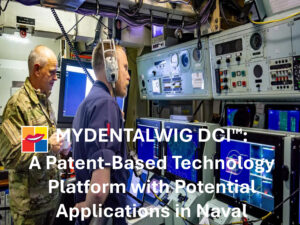
MYDENTALWIG | Technology Research and Development
Introduction: Looking Beyond the Original Application
Technologies are not always limited to the industries for which they were initially conceived. As engineering advances, an architecture developed for one application may inspire new possibilities in sensing, computing, communications, and intelligent electronic systems.
MYDENTALWIG is exploring this broader perspective through its Dental Computing Interface™ (DCI™), a patent-based technology initiative originating within its dental technology ecosystem.
The company’s current interest is whether selected architectural principles associated with DCI™ could provide a foundation for further research into compact electronics, sensor integration, signal processing, and hardware-software interfaces.
One area of investigation is the potential relevance of these concepts to specialized electronic systems, including certain naval electronics applications.
This is an early-stage research direction. The objective is to determine what the underlying architecture can technically support, which elements might be transferable to other applications, and what additional engineering would be required.
DCI™: Investigating a Technology Platform
The DCI™ concept raises a broader engineering question: can principles developed within a dental technology platform be adapted to address other electronic integration challenges?
Answering this question requires examining the actual patent claims and technical disclosure, identifying the architecture’s defined functions, and determining whether those functions can be implemented and tested using existing development hardware.
Potential areas for technical investigation include:
- Sensor interfaces and data acquisition.
- Signal processing and electronic integration.
- Communication between compatible hardware components.
- Power-management approaches.
- Modular hardware and software architectures.
These are areas for investigation, not a representation that DCI™ already implements every capability listed above. Their relevance must be established through patent review, engineering analysis, and testing.
At this stage, DCI™ should be understood as a patent-based architecture rather than a completed custom semiconductor or a qualified defense electronics product.
The research objective is to establish a technically defensible pathway from the underlying invention to a demonstrable application.
Exploring Potential Applications in Naval Electronics
Modern naval platforms depend on electronic systems that must exchange information across diverse equipment, interfaces, and generations of technology.
Integrating legacy equipment with modern processing and networking infrastructure can create substantial engineering challenges. Interfaces must be compatible, signals must be interpreted correctly, and systems must meet demanding requirements for reliability, environmental resilience, cybersecurity, and maintainability.
These challenges provide a possible context for investigating modular electronic architectures.
Potential Application 1: Shipboard Input-Output Systems
The U.S. Navy’s FY2027 SBIR topic DON27BZ01-NV004 concerns the development of a modern, modular Input-Output Unit capable of interfacing with legacy and modern shipboard systems and processing and routing hull, mechanical, electrical, and navigation signals.
The topic provides a relevant point of reference for exploring whether selected DCI™ architectural concepts could inform research into modular sensor interfaces or signal-processing components.
A preliminary investigation could examine:
- The requirements for interfacing with multiple compatible signal sources.
- Potential approaches to modular processing and data routing.
- The feasibility of implementing selected functions on existing development hardware.
- The additional requirements for environmental protection, cybersecurity, reliability, and integration with shipboard systems.
Any proposed naval implementation would require a detailed requirements assessment and appropriate engineering validation. No claim is made that the current DCI™ architecture already meets Navy specifications.
Potential Application 2: Sensor Integration for Augmented Reality
MYDENTALWIG is also interested in the relationship between compact electronics, sensor integration, and augmented-reality systems.
Military and industrial augmented-reality platforms may combine displays, motion sensors, computing hardware, communications, and external data sources to deliver information within a user’s field of view.
This raises an exploratory question: could a dental appliance or another compact dental-device form factor eventually contribute a useful sensing or interface function to a larger wearable computing system?
In such an architecture, a dental component would not necessarily generate the visual display or perform the system’s most computationally demanding tasks. Instead, if technically justified, it might serve as one component in a system that includes external processing, tracking, communications, and a helmet-mounted or glasses-based display.
The concept would require investigation of practical constraints, including device size, available power, thermal behavior, biocompatibility, wireless communication, and the value of locating a particular sensor or interface within a dental appliance rather than a conventional wearable.
The Navy’s FY2027 SBIR topic DON27BX01-NP001, which concerns heads-up-display hardware for first-person-view drone pilots and augmented-reality applications, provides another potential area for evaluating relevant technologies. However, any proposal would need to satisfy the topic’s specific requirements concerning existing hardware and display or motion-tracking capabilities.
DCI™ alone should not be presented as satisfying those requirements without supporting technical evidence.
From Patent Architecture to Engineering Demonstration
A central objective for MYDENTALWIG is to determine how a patent-based concept might progress toward a practical, testable technology.
The proposed development pathway has three initial stages.
Stage 1: Patent and architecture review
Review the actual patent claims and technical disclosure to identify the architecture’s defined components, inputs, outputs, interfaces, processing functions, and power assumptions.
Stage 2: Feasibility assessment
Determine whether selected functions can be modeled, simulated, or reproduced using existing development boards and electronic components. This stage would establish which elements are technically feasible and where additional engineering is necessary.
Stage 3: Application-specific demonstrator
If the feasibility assessment supports further development, define a limited demonstration around a measurable function, such as acquiring a specified sensor signal, processing it, and transmitting the resulting information to an external computing or display system.
The purpose would be to generate evidence, establish performance limits, and determine whether custom hardware development is justified.
A successful demonstration of one function would not, by itself, establish suitability for naval deployment or prove that the full DCI™ concept can support every proposed application.
A Research-Driven Approach to Commercialization
MYDENTALWIG’s approach is to investigate opportunities systematically rather than assume that an architecture can be transferred directly between industries.
Potential commercialization would depend on several factors:
- The scope and technical substance of the patent claims.
- Demonstrable advantages over existing solutions.
- The cost and complexity of implementation.
- Compatibility with the target system’s interfaces and operating requirements.
- Applicable intellectual-property, safety, export-control, and regulatory requirements.
- The availability of suitable engineering and commercialization partners.
For defense-related applications, these considerations would be especially important. Environmental qualification, cybersecurity, reliability, and integration requirements would need to be addressed through an application-specific development program.
Why This Navy Opportunity Matters to MYDENTALWIG and Its Investors
The relevance of this opportunity lies in the engineering challenge the Navy is seeking to address: integrating diverse sensor signals, processing information, and enabling reliable communication between legacy and modern electronic systems. These requirements provide a concrete context in which MYDENTALWIG can investigate whether selected principles of its DCI™ patent-based architecture could have applications beyond dentistry. The Navy’s FY2027 SBIR Input-Output Unit topic, DON27BZ01-NV004, therefore represents a potential point of alignment for preliminary research into modular interfaces, signal processing, and electronic integration. This alignment is exploratory, not a determination of technical suitability or eligibility. The next step would be to examine the actual DCI™ patent claims, map them against the published Navy requirements, and identify a specific function that could be modeled or demonstrated through engineering development.
Looking Ahead
The broader vision behind DCI™ is to investigate whether a patent-based technology architecture originating in dental innovation could contribute to other areas of electronics and intelligent systems.
Naval signal processing and augmented-reality sensor integration represent two distinct areas worth evaluating. Their technical requirements differ, and each would require its own feasibility assessment and development pathway.
The immediate priority is to establish exactly what the patented architecture describes, identify the functions it can support, and determine whether those functions offer a meaningful advantage in a defined application.
MYDENTALWIG views this process as an opportunity to connect original innovation with disciplined engineering, evidence-based development, and potential new markets.
The objective is not to assume that a technology is ready for an entirely new industry. It is to investigate, demonstrate, and validate whether it can become useful there.
This article describes an exploratory research and development direction. It does not represent a claim of Navy endorsement, contract award, military qualification, demonstrated augmented-reality functionality, or compliance with naval electronics specifications. Specific technical capabilities remain subject to verification against the applicable patent documentation and engineering evidence.
This article was first published HERE