
AI is becoming capable of creating new algorithms, but creating better algorithms does not automatically give AI access to more of reality.
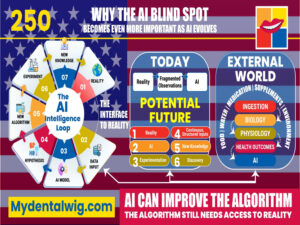
Artificial intelligence is entering a new phase: AI Can Create New Algorithms.
But Can It See What It’s Missing?
For years, we largely thought of AI as something humans programmed, trained, and instructed.
That model is changing.
Increasingly capable AI systems can generate code, develop new methods, test hypotheses, optimize solutions, and, in some cases, discover algorithms that humans did not explicitly design.
This raises an extraordinary possibility:
What happens when AI begins improving the algorithms that make AI more capable?
The implications are enormous.
But there is another question that may be equally important—and perhaps much less discussed:
Can AI discover what it cannot see?
Consider the extraordinary amount of information available to modern AI.
It can process text.
Images.
Video.
Audio.
Sensor data.
Scientific literature.
Genomic information.
Financial data.
Satellite imagery.
Medical records.
And increasingly, AI can combine these different forms of information to discover patterns that humans may overlook.
Yet there is a fundamental distinction between processing more information and having access to the information that matters most.
An AI system can create a better algorithm for analyzing a dataset.
It can discover a new mathematical relationship.
It can generate a hypothesis.
It can design an experiment.
It can even improve the method used to search for future discoveries.
But if a critical variable is missing from the underlying representation of reality, a more sophisticated algorithm does not necessarily solve the problem.
The machine may become better at analyzing the picture without ever receiving the missing piece of the picture.
This leads to a broader principle:
AI intelligence is increasingly limited not only by computation, but by its interfaces to reality.
That distinction becomes especially important in healthcare.
Human health is not produced by medical records.
Medical records are records of what happened to a human being.
The underlying biological process begins much earlier.
Something enters the body.
The body responds.
Metabolism changes.
Hormones respond.
The immune system responds.
The microbiome interacts.
Cells respond.
Physiology changes.
Eventually, symptoms may appear.
A diagnosis may follow.
A medical image may reveal the consequence.
A laboratory test may measure the result.
And an AI system may then learn to predict that outcome.
But what if the AI could also continuously understand the beginning of that chain?
What if it could understand the inputs that preceded the outcome?
Food.
Water.
Nutrients.
Medications.
Supplements.
Environmental exposures.
Timing.
Dose.
Interactions.
The question is not whether AI can process this information.
Of course it can.
The question is whether the information exists in a sufficiently structured, continuous, reliable, and interoperable form for AI to use it effectively.
This is a fundamentally different problem.
It is an input architecture problem.
And it may become increasingly important as AI becomes more autonomous.
Imagine a future AI system capable of:
Generating a hypothesis → creating an algorithm → testing the algorithm → analyzing the results → improving the algorithm → generating a new hypothesis.
That is a powerful feedback loop.
But every feedback loop depends on what enters it.
The more intelligent the system becomes, the more consequential the quality of its inputs may become.
This suggests a provocative possibility:
The next bottleneck in artificial intelligence may not be intelligence itself. It may be access to reality.
This does not mean that today’s AI is incapable of understanding the world.
Nor does it mean that AI cannot discover information that humans have overlooked.
Quite the opposite.
AI may become extraordinarily capable of discovering new knowledge from existing information.
But there is a difference between discovering hidden patterns in the information available to a system and discovering patterns that require information the system has never received.
That distinction is particularly important in biology.
Human beings are not simply collections of medical records.
We are continuously interacting with our environment.
We consume.
We absorb.
We metabolize.
We respond.
We adapt.
We change.
And those processes create the biological reality that eventually becomes the data AI sees.
Perhaps the next generation of AI will not be defined solely by larger models, more computing power, or increasingly sophisticated algorithms.
Perhaps it will also be defined by better interfaces between AI and the physical world.
Interfaces that allow machines to observe reality more continuously.
More precisely.
And closer to the beginning of the causal chain.
This brings us back to healthcare.
If AI is becoming capable of generating increasingly sophisticated intelligence, then perhaps healthcare’s greatest opportunity is not simply to give AI more medical records.
Perhaps it is to give AI access to a richer representation of what happens before the medical record exists.
That is where the ingestion layer becomes particularly interesting.
Because ingestion is not merely another healthcare dataset.
It may represent one of the earliest interfaces between the external world and human biology.
And if we can make that interface structured, continuous, measurable, and machine-readable, we may give the next generation of AI something it has never had at scale:
a richer window into the beginning of human biological change.
The question for the future may therefore not be:
“How intelligent can AI become?”
But also:
“How much of reality can we give AI the ability to see?”