
The next question is:
What infrastructure connects increasingly intelligent machines to continuously changing human biology?
In the previous articles, we explored a question that may become increasingly important as artificial intelligence advances:
How much of reality can AI actually see?
AI can analyze extraordinary amounts of information.
It can process language, images, video, audio, sensor data, scientific literature, medical records, and increasingly complex biological datasets.
It can discover patterns that humans may not recognize.
It can generate hypotheses.
It can write code.
It can develop new methods and algorithms.
And the trajectory is clear: AI is moving from simply analyzing information toward actively participating in the process of discovery.
But there is a fundamental limitation that deserves attention.
Intelligence cannot compensate indefinitely for an incomplete interface to reality.
In healthcare, this problem becomes particularly significant.
Human health begins long before a diagnosis appears in a medical record.
Something enters the body.
Food.
Water.
Nutrients.
Medication.
Supplements.
Environmental exposures.
Other substances.
The body then processes those inputs through extraordinarily complex biological systems.
Metabolism changes.
The microbiome responds.
Hormones respond.
The immune system responds.
Cells respond.
Physiology changes.
Over time, those changes may contribute to health or disease.
Eventually, some of that biological history becomes visible to healthcare systems through symptoms, laboratory tests, medical images, wearable devices, clinical notes, and diagnoses.
This means that much of today’s healthcare data represents the downstream consequences of biology.
But what about the beginning of the chain?
What if we could capture that beginning more systematically?
What if ingestion could become a structured, longitudinal, machine-readable layer of healthcare information?
That is the question behind DCI.
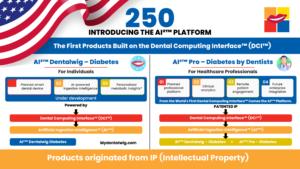
DCI is our patented technology designed around the concept of creating a structured interface between human ingestion and digital intelligence.
The objective is not simply to collect another category of health data.
The larger objective is to create a framework through which ingestion-related information can potentially become useful to increasingly intelligent computational systems.
This distinction matters.
A database of food entries is not necessarily an ingestion intelligence layer.
A medication list is not necessarily an ingestion intelligence layer.
A nutrition app is not necessarily an ingestion intelligence layer.
The opportunity is to connect ingestion information with the biological consequences that follow.
In its simplest conceptual form:
INGESTION → BIOLOGY → PHYSIOLOGY → HEALTH OUTCOME
Now imagine connecting that pathway to AI.
INGESTION → BIOLOGY → PHYSIOLOGY → DATA → AI → PREDICTION → INTERVENTION → OUTCOME
The resulting system is fundamentally different from an AI model that only receives the downstream clinical record.
It potentially gives AI a richer representation of the events that preceded the outcome.
And that distinction could become increasingly important as AI becomes more capable.
The more powerful AI becomes, the more valuable the information entering the system may become.
This is why we believe DCI should not be viewed merely as another healthcare application.
It should be considered as a potential input architecture for healthcare intelligence.
The analogy is simple.
Computers became extraordinarily powerful, but their usefulness depended on interfaces that allowed humans and machines to exchange information.
The internet transformed computing by creating an enormous infrastructure for information exchange.
Mobile technology put sensors and computing into people’s hands.
AI is now transforming the way machines process information.
The next question is:
What infrastructure connects increasingly intelligent machines to continuously changing human biology?
That is the opportunity we see in the ingestion layer.
DCI is designed around that opportunity.
But there is an important distinction between a vision and a validated outcome.
Our goal is to make sure that capturing more ingestion data automatically produces better healthcare.
The data must be accurate.
It must be standardized.
It must be longitudinal.
It must be connected appropriately to biological and clinical outcomes.
It must protect privacy.
It must be clinically validated.
And ultimately, its value must be demonstrated through measurable improvements in prediction, prevention, treatment, or health outcomes.
Those are not small requirements.
They are precisely what makes this an infrastructure challenge rather than simply a software feature.
Successfully executed, the implications will extend beyond a single healthcare application.
Imagine a future in which increasingly capable AI systems can access a much richer representation of human biological inputs.
AI could potentially analyze relationships between ingestion and physiology at a scale that would be difficult for individual clinicians or researchers to examine manually.
It could potentially identify patterns across populations.
It could potentially help researchers formulate new hypotheses.
It could potentially support earlier interventions.
And it could potentially create entirely new categories of preventive health intelligence.
The goal is not to replace physicians.
The goal is not to replace human judgment.
The goal is to give intelligent systems better information about the human beings they are trying to understand.
That is the central idea behind DCI™.
AI is becoming increasingly intelligent.
The question is whether our healthcare infrastructure is becoming equally capable of giving that intelligence access to the biological reality it is trying to understand.
We believe one of the missing interfaces is the ingestion.
And we believe DCI is becoming part of that interface.
The future of AI depends not only on how intelligent machines become.
It depends on how effectively we connect those machines to reality.
DCI™ is our path to build that connection—beginning with the first interface between the outside world and human biology: ingestion.