
MYDENTALWIG is exploring Dentalwig PLUS™ – Augmented Reality as a proposed extension of its dental-device platform.
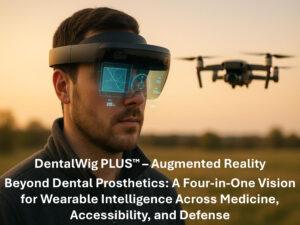
MYDENTALWIG™ | Dentalwig PLUS™ – Augmented Reality
Concept exploration · Medical technology · Assistive technology · Human–machine interfaces
I- What is augmented reality, and why does it matter?
Augmented reality (AR) is a technology that adds computer-generated information to a person’s perception of the real world. Through smart glasses or other compatible devices, users may see contextual information, directions, labels, visual instructions, or other digital elements while remaining aware of their physical surroundings.
Unlike virtual reality, which can immerse a user in a simulated environment, AR combines digital information with the existing world.
AR is relevant because it can change how people access information. Rather than looking down at a phone or consulting a separate screen, a user may receive information directly through a wearable interface.
Depending on the system, that information can also be supported by audio, voice interaction, or other sensory feedback. These capabilities create opportunities in healthcare, accessibility, education, industrial operations, and defense.
II- Introducing Dentalwig PLUS™ – Augmented Reality
What if the technology behind a dental prosthesis could serve a purpose beyond replacing missing teeth?
MYDENTALWIG is exploring Dentalwig PLUS™ – Augmented Reality as a proposed extension of its dental-device platform. The concept brings together three complementary functions: dental restoration, potential monitoring of selected physiological or behavioral inputs, and interaction with augmented-reality glasses.
The objective is to investigate whether a familiar dental appliance could become part of a broader wearable technology system.
III. The four-in-one concept
- Dental restoration
Replacing missing teeth
The foundation is the Dentalwig itself: a dental appliance intended to replace missing teeth without having to go to the dentist. This established physical function distinguishes the concept from smart glasses alone.
The proposed PLUS version explores how electronic functions might coexist with the appliance’s dental purpose, subject to appropriate design, comfort, safety, and clinical assessment.
- Upstream intelligence
Monitoring selected inputs
The mouth is an important point of entry into the body. Depending on the sensors and electronics developed, a smart dental appliance could capture information about chewing, bite activity, and meal timing etc.
This upstream perspective could complement downstream measurements, such as glucose readings from a continuous glucose monitor (CGM), by helping researchers investigate relationships between ingestion behavior and physiological responses.
Future applications depends on validated sensors, reliable data transmission, and appropriate analytical models. Broader continuous body monitoring should not be assumed without additional technical capabilities.
- External-world intelligence
Augmented reality through smart glasses
The third function is the proposed integration with compatible AR glasses. These glasses could display information about the surrounding environment, provide contextual guidance, or present data supplied by connected devices.
In the MYDENTALWIG vision, the dental appliance and the glasses would form parts of a larger system. The communication link, allocation of processing, and actual functions will need to be engineered and tested.
The proposed differentiator: Dentalwig PLUS™ – Augmented Reality is envisioned as combining dental restoration, potential intraoral monitoring, and an external-world digital interface within one integrated concept. It is not simply another pair of AR glasses.
- A potential medical application:
i)- Supporting people with visual impairments
Augmented reality may also offer important possibilities for people who are blind or have low vision.
Camera-equipped smart glasses, computer vision, and AI-based systems can potentially help users interpret their surroundings by describing objects, recognizing text, identifying landmarks, or providing audio guidance.
For people with low vision, appropriately designed visual overlays may also improve access to selected information when the hardware and the user’s remaining vision permit it.
This raises an interesting research question: could a future Dentalwig PLUS™ system provide an additional interface through which users interact with assistive technologies?
For example, a compatible system might eventually support the presentation of contextual information or personalized guidance through audio or visual output. The dental appliance might serve as one component of that system, but it would not itself restore vision.
Importantly, the potential accessibility benefit would come from the complete system—sensors, cameras, software, processing, and output devices—not merely from embedding electronics in a dental appliance.
Any such application would require dedicated development and testing with people with visual impairments. Safety-critical navigation, obstacle avoidance, and independent mobility would need particularly rigorous validation.
2i)- PTSD Prevention ─ From a personal story to a vision for military psychological health
The inspiration for exploring this additional application came from a deeply personal story shared by my husband, Dr. J. M. Livolsi, a retired French military officer and physician. We met in 1998, and he told me about a military operation in Chad during the 1990s. During a Libyan attack, a French officer was wounded inside a helicopter on the ground. With bullets flying overhead, my husband screamed, “Cover me!” asking the team to cover him from bullets. He ran toward the helicopter, reached the wounded officer, and brought him back to the safety of the military camp. When I heard his story, I thought not only about the extraordinary courage required to act under such circumstances, but also about the immense physical and psychological stress his body must have experienced. Years later, after watching a video about sensors embedded in an F-15 pilot’s equipment, I began imagining a broader possibility: what if we could combine information about the external environment with continuous monitoring of selected internal physiological signals? Could MYDENTALWIG’s vision of Dentalwig PLUS™ – Augmented Reality, together with its proposed intraoral sensing capabilities and EI²™ (Extraordinary Ingestion Intelligence) approach, contribute to a more comprehensive understanding of how the human body responds to extreme operational stress? Over time, appropriately validated data and AI-based analysis might help researchers identify individual patterns of stress and recovery, support early assessment, and investigate new approaches to resilience and PTSD prevention. This remains a research vision, not an established capability or a proven method of preventing PTSD. But it reflects the deeper mission behind MYDENTALWIG: Prevention is better than cure.
IV- Beyond medicine: Potential applications in defense and intelligence
The combination of wearable sensing and AR interfaces may also be relevant to organizations that require hands-free access to information in demanding environments.
- U.S. Navy: Potential research into wearable interfaces and contextual information delivery for personnel in operational environments.
- U.S. Air Force: Exploration of human–machine interfaces that could complement existing wearable and mission-support systems.
- U.S. Space Force: Potential applications involving complex information environments and specialized human–computer interaction.
- Intelligence agencies, including the CIA: Research possibilities involving wearable computing, information access, and discreet human–machine interfaces, subject to operational and security requirements.
- Other government and commercial sectors: Potential applications in industrial training, remote assistance, accessibility, and specialized professional environments.
These are prospective application areas, not confirmed customer requirements, agency endorsements, or existing partnerships. Any defense application would need to demonstrate a meaningful advantage over existing technologies and satisfy stringent requirements for security, reliability, ergonomics, and integration.
V- Why the dental-device approach deserves investigation
Most AR products begin with the glasses or another external wearable. Dentalwig PLUS™ – Augmented Reality proposes a different starting point: a dental appliance that already has a physical function and could potentially become part of a larger electronic ecosystem.
This raises several engineering and commercial questions:
- Can electronic components be integrated without compromising the appliance’s dental function?
- What useful information could be acquired from the oral environment?
- How could power, communication, and data security be managed?
- What additional value would connecting the dental appliance to AR glasses provide?
- Would the combined system offer advantages that justify its complexity and cost?
These questions define a research and development opportunity rather than a proven competitive advantage. A feasibility study and comparisons with existing technologies would help establish whether the concept can deliver meaningful benefits.
VI- Intellectual property and development roadmap
MYDENTALWIG’s broader strategy is to develop a family of PLUS applications based on its dental-device technology and associated intellectual property.
The company’s Dentalwig PLUS™ – Diabetes concept focuses on ingestion sensing, meal timing, and correlation with CGM data. The Augmented Reality concept explores a different direction: combining dental restoration and potential sensing capabilities with a wearable visual interface.
A practical development program could include:
- Architecture definition: Identify the proposed functions and how the dental appliance, electronics, external processing, and glasses would interact.
- Technical feasibility: Evaluate sensor integration, power, communication, materials, and ergonomics.
- Prototype or simulation: Test selected functions and document actual results.
- Application-specific validation: Assess medical, accessibility, or operational use cases against their respective requirements.
- Commercial assessment: Determine whether the validated capabilities offer sufficient value for a defined target market.
VII. Conclusion: One Dental Platform, Four Interconnected Directions for Wearable Intelligence
Dentalwig PLUS™ – Augmented Reality represents an exploratory extension of MYDENTALWIG’s vision: combining the practical function of a dental prosthesis with potential intraoral sensing, augmented-reality interfaces, and AI/EI-driven analysis to investigate new possibilities across medicine, accessibility, and defense.
The proposed four-in-one vision brings together dental restoration, upstream monitoring of selected inputs, augmented perception of the external world, and the potential analysis of physiological stress and recovery patterns. By exploring how information about a person’s internal state could be considered alongside data about the surrounding environment, MYDENTALWIG aims to investigate new approaches to wearable intelligence, including potential research applications in military psychological health and PTSD prevention. This ambition is inspired, in part, by the personal experience of a retired French military officer and physician whose account of rescuing a wounded colleague under fire prompted a fundamental question: could future technology help us better understand the human body’s response to extreme operational stress?
For investors, engineering partners, medical researchers, and defense stakeholders, the opportunity is to assess whether this concept can be translated into a technically feasible, commercially meaningful system. The exploration of emerging government technology opportunities, including relevant U.S. Navy SBIR topics, provides an additional context for evaluating potential defense applications, without implying an existing contract, endorsement, or validated operational capability.
The next step is to define the system architecture, assess the relationship between the proposed functions and MYDENTALWIG’s intellectual property, identify relevant development and funding opportunities, and determine which capabilities can be demonstrated through engineering, testing, and application-specific validation.
Ultimately, this vision extends beyond dental technology. It reflects MYDENTALWIG’s broader mission to explore how wearable intelligence might contribute to better health, improved human–machine interaction, and the protection of those who serve in demanding environments—all guided by a principle that remains central to our purpose: Prevention is better than cure.