
A personal statement about women founders, marriage, entrepreneurship, and investor confidence.
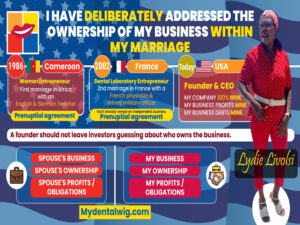
I have deliberately addressed the ownership of my business within my marriage. I am currently separated and our final divorce is in process.
There is an important conversation taking place about women founders and the extraordinary disparity in access to investment capital.
I have been an entrepreneur for decades, and I believe there is another conversation we should be willing to have openly:
What happens to a woman’s business if her marriage ends?
I believe this question can matter to investors.
I also believe that women founders should not wait for an investor to wonder about it.
That is why I am addressing it directly.
I have been thinking about this since 1986
I did not discover the importance of protecting business ownership because I am raising capital today.
I understood it when I was a young entrepreneur.
In 1986, in Africa, before my first marriage, I requested and signed a prenuptial agreement.
At that time, I already understood something that has remained part of my philosophy throughout my entrepreneurial life:
Marriage and business ownership are two different things.
A marriage is a personal relationship.
A business is an economic enterprise that can involve intellectual property, employees, contracts, customers, liabilities, profits, debts, and years of work.
I wanted that distinction to be clear.
Then came 2002
In 2002, I was preparing to marry again.
The marriage took place in France.
My future husband was a French physician and retired French military officer, and he already owned his medical practice.
I already owned my dental laboratory business.
We were both entrepreneurs with businesses that existed independently of our marriage.
I was the one who raised the subject of a prenuptial agreement.
I contacted a lawyer myself.
I explained why I considered the agreement important and asked the lawyer to meet with both of us and explain the agreement clearly to my future husband.
He was initially surprised that I was thinking about this so openly.
But after having the opportunity to understand the agreement and its purpose, he agreed.
The principle was straightforward:
His business was his.
My business was mine.
The agreement established the separation of our respective business interests, including the respective profits and debts of those businesses, according to its terms.
That agreement was made in 2002.
It was not created because I was seeking investors.
It was not created because I expected my marriage to fail.
It was created because I believed that two entrepreneurs should know exactly where their respective business ownership begins and ends.
I still believe that.
Why am I talking about this now?
Because today I am a woman founder seeking significant capital to build a company.
And I want potential investors to know something before they have to ask:
I have deliberately addressed the ownership of my business within my marriage.
I don’t want an investor wondering:
“What happens to her company if she gets divorced?”
That question has already been addressed through my prenuptial agreement.
Under the agreement, each spouse retains ownership of his or her respective business interests, including the applicable profits and debts of those businesses, subject to the specific terms of the agreement.
In simple terms:
My company is my company.
My spouse’s company is his company.
The existence of our marriage does not, under our agreement, create an ownership interest for one spouse in the other’s business.
That distinction matters to me.
And I believe it can matter to investors.
Why women founders should be willing to discuss this
I know this is an uncomfortable subject.
But entrepreneurship is about confronting uncomfortable subjects.
We routinely discuss:
- capitalization;
- debt;
- intellectual property;
- corporate structure;
- dilution;
- management;
- contracts;
- litigation;
- regulatory risk;
- succession;
- key-person risk;
- and exit strategies.
Why should we be afraid to discuss ownership risks associated with a founder’s personal circumstances?
I believe women founders should be particularly willing to address this issue because the investment world still has a significant gender imbalance.
Investors are human beings. They bring their experiences, assumptions, fears, and expectations to investment decisions.
Many investors are men.
Many men have personal experience with marriage, divorce, family finances, and the division of assets.
Some may therefore have questions about what happens to a woman’s business if her marriage ends.
I would rather answer that question before it is asked.
I am not saying that every woman needs the same arrangement
This is not legal advice.
It is not a statement that every marriage should have a prenuptial agreement.
And it is certainly not an argument that marriage and entrepreneurship are incompatible.
It is my personal experience and my philosophy as an entrepreneur.
I believe that if a woman is building a company, she should understand exactly what happens to that company under the legal arrangements governing her marriage.
She should know who owns it.
She should know what happens to its profits.
She should understand its liabilities.
And if she is seeking outside capital, she should consider whether there are circumstances in her personal life that could create unnecessary uncertainty for investors.
Clarity is not distrust.
Planning is not pessimism.
Protecting ownership is not planning for failure.
It is simply responsible entrepreneurship.
I made this decision before anyone was investing in me
This is perhaps the most important part of my story.
My prenuptial agreements were not created to impress investors.
They were created long before today’s fundraising.
In 1986, I made that decision before my first marriage.
In 2002, I made that decision again before my marriage in France.
I was already an entrepreneur.
My future husband was already an entrepreneur and physician.
We both had businesses.
And we deliberately established a structure in which each person’s business remained that person’s business.
That is the same philosophy I bring to entrepreneurship today.
To potential investors
If you are considering investing in a company I founded, I want you to know that I take ownership seriously.
I have spent decades building businesses.
I have created intellectual property.
I have assumed business responsibilities.
I understand the difference between personal life and business ownership.
And I have taken deliberate steps to protect that distinction.
I do not expect investors to simply trust me because I say so.
I believe investors deserve transparency.
That is why I am telling you this upfront.
My marriage is a personal relationship.
My company is a business.
And under my prenuptial agreement, my spouse does not acquire an ownership interest in the company I built merely because we are married.
That is a distinction I established decades ago.
And it is a distinction I intend to maintain.
A final message to women entrepreneurs
For women who are building companies, I have one simple message:
Do not be afraid to talk about ownership.
Do not wait until you are raising millions of dollars to discover that you have never clearly considered how your personal legal circumstances could affect the business you spent years building.
Think about it early.
Understand it.
Document it.
Protect it.
And when the time comes to ask other people to invest in what you built, don’t leave them guessing.
I didn’t.
I addressed it in 1986.
I addressed it again in 2002.
And I am addressing it publicly today.
I am a woman founder.
I built my businesses.
I know who owns them.
And I want my investors to know, too.