
There is a difference between discovering hidden patterns in available information and having access to information that was never captured in the first place.
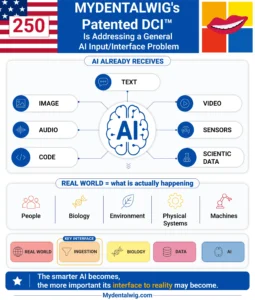
Artificial intelligence is advancing at extraordinary speed.
AI systems can read books, analyze images, understand video and audio, process sensor data, write software, generate hypotheses, and increasingly create new algorithms.
The question is no longer simply:
How intelligent can AI become?
There is another question that may be just as important:
What can AI actually see?
Today, AI receives enormous amounts of information created by humans and collected by machines.
But much of that information is an observation, a record, or an outcome.
A book is an output of human thought.
A video is an output of human behavior.
An audio recording is an output of communication.
A medical image is an observation of biological conditions.
A laboratory result is an observation of physiology.
A sensor records a measurable state.
AI can become extraordinarily sophisticated at analyzing all of these things.
But analyzing an output is not necessarily the same as having access to everything that produced it.
That distinction leads to what we believe is a fundamental problem:
AI needs better interfaces to reality.
Healthcare provides one of the clearest examples.
Human health does not begin with a diagnosis.
It begins much earlier.
Something enters the body.
Food.
Water.
Nutrients.
Medication.
Supplements.
Environmental exposures.
Those inputs interact with biology.
The body responds.
Metabolism changes.
The microbiome changes.
Hormones respond.
The immune system responds.
Physiology changes.
Eventually, some of those changes become visible through symptoms, laboratory tests, images, diagnoses, and other forms of healthcare data.
Today’s AI can analyze many of those downstream signals.
But what about the beginning of the chain?
What if AI could have structured access to the information about what entered the body and what happened afterward?
That is where we believe DCI becomes important.
DCI is not simply another healthcare application.
It is our patented technology addressing what we see as a broader AI input/interface problem.
The concept is straightforward:
AI is only as connected to reality as the interfaces through which information reaches it.
This does not mean AI cannot discover new information.
It can.
AI can identify patterns humans missed.
It can generate hypotheses.
It can create algorithms.
It can design experiments.
It can discover new methods.
But there is a difference between discovering hidden patterns in available information and having access to information that was never captured in the first place.
A more powerful algorithm does not automatically create a missing input.
That is why we believe the next generation of AI infrastructure will involve more than processors, models, and software.
It will also require better ways to capture and structure information from the physical world.
Healthcare is simply one of the most compelling places to begin.
The human body is continuously interacting with its environment.
It consumes.
It absorbs.
It metabolizes.
It responds.
It changes.
Capturing those processes creates an opportunity to connect external inputs with biological outcomes in ways that have historically been fragmented.
And this concept does not necessarily end with healthcare.
The same fundamental question appears wherever AI interacts with the physical world.
How does AI obtain information from reality?
How continuously?
How accurately?
How directly?
How much context accompanies the information?
And what important variables are missing?
These questions become even more important as AI becomes more autonomous.
An AI system capable of generating its own algorithms may be extraordinarily powerful.
But its algorithms still operate on information.
Its experiments still require observations.
Its hypotheses still require feedback.
Its intelligence still needs an interface to the world it is trying to understand.
This is why we believe the future of AI will involve not only increasingly intelligent models, but increasingly sophisticated input architectures.
DCI begins with one of the most fundamental interfaces between the outside world and human biology:
ingestion.
Our approach is to use healthcare as an understandable and tangible entry point into a much larger technological opportunity.
The goal is not to replace AI.
The goal is not to compete with AI models.
The goal is to create a richer interface through which AI can potentially access information about reality.
In simple terms:
AI provides intelligence.
DCI addresses the input/interface.
And the more intelligent AI becomes, the more important the quality of that interface may become.
That is why we believe DCI has significance beyond healthcare.
Healthcare is where we begin.
But the underlying problem is much broader:
How do we give increasingly intelligent machines better access to the reality they are trying to understand?